

On this page
Which Birdeye use are you replacing?
The Birdeye Data overview describes token, pair, wallet and market data, including prices, candles, liquidity, holders and PnL. Its developer quickstart calls for an account and API key. This establishes a data-service use case; it does not mean every dataset has identical chain coverage or access conditions.
Build a small requirements sheet first
| Requirement | A useful specification | What would fail the test |
|---|---|---|
| Price | Exact mint or pair, quote currency, freshness threshold and missing-value behavior. | An old value presented as current, or a different pool silently substituted. |
| History | Time range, candle interval, timezone and treatment of empty periods. | A chart that starts later than required without indicating the gap. |
| Wallet PnL | Observed history, transfer treatment and realized/open separation. | A total that cannot be reconciled with its underlying positions. |
| Holder analysis | Snapshot time, supply basis and coverage for early buyers. | Missing coverage displayed as zero concentration. |
| Operations | Expected requests, error handling and recovery after interruption. | A proof of concept that only works during one successful response. |
Evaluate BLIX as a research workspace
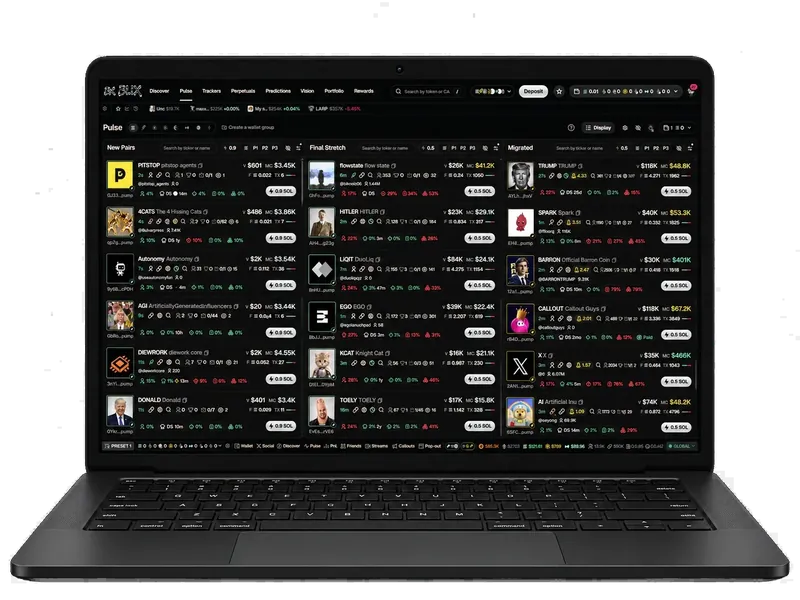
For someone investigating Solana tokens directly, BLIX combines discovery, wallet context, holder analysis and AI research in a ready-to-use terminal. That can reduce the amount of interface building required to inspect a trade idea. Start with the terminal guide and a known token rather than a synthetic feature checklist.
For a team serving a broad external application, the requirements can be different. A terminal's available observations do not establish a historical archive, contractual uptime, identical chain coverage or a supported replacement for another provider's schema. Confirm those needs before adopting any data source.
How to investigate a disagreement
Suppose two wallet views show different profit. First align the currency and observation period. Then separate current holdings from completed sales and check for transfers or missing entry prices. Finally inspect the price source used for still-open positions. A different total may be an accounting difference rather than a broken feed.
Write down that explanation. A successful evaluation should leave you able to explain the numbers, not merely select the larger one.
A bounded evaluation
- Choose several tokens with different histories, including one with a sparse market.
- Compare the same fields and time windows.
- Test a wallet with transfers as well as swaps.
- Observe how stale or unavailable data is presented.
- Compare the work needed to answer your actual research question.
Current plan limits and pricing belong in a separate dated provider check. This guide does not publish an untested cheapest-provider ranking.
Sources and method
Reviewed by BLIX on October 10, 2026. This guide uses primary documentation and explains how to evaluate a workflow. It does not claim a hands-on execution test, a fee comparison or a trading-return advantage.
BLIX publishes this guide about its own product and is independent of the vendors named. Links contain no referral codes. Discuss corrections in the BLIX Discord.
Frequently asked questions
Does BLIX replace Birdeye's historical datasets?
No equivalent archive or historical coverage is established here. Specify the dates and fields you need, then verify each source against that requirement.
Should I choose a data API or a terminal?
Choose an API when you need to build a product around defined data responses. Evaluate a terminal when your primary task is investigating tokens and managing your own workflow.